

Unlock 10% off on your first order and gain access to exclusive, limited-edition projects.
The Handmade Straw Hat, Reimagined: SUPERDUPER's Approach to Authentic Craft

There's a moment when you put on a well-made straw hat and something just clicks. The weight sits right. The brim holds its line. It doesn't feel like you're wearing a hat. It feels like the hat belongs there. That moment doesn't happen by accident. It happens because someone made a series of very deliberate decisions about material, tension, and construction, and then made them again with the next hat, and the one after that.
This is what we think about when we talk about "handmade". Not the romance of it. The result.
Why handwork still matters
The honest answer is: because nothing else produces the same outcome.
When a weaver works a straw plait by hand, they're making continuous small adjustments: to tension, to the angle of each thread, to the way the braid wants to move. Those adjustments happen thousands of times across a single hat. They accumulate into a structure with an internal coherence that machine production simply can't replicate.
A factory hat is consistent. A handmade hat is calibrated. The difference is subtle until you hold both, and then it's obvious.
At SUPERDUPER, every straw hat is handwoven in our Florentine Atelier. Not as a statement, but because it's the only way to get the result we're after.
The material: why we use Premium wheat straw
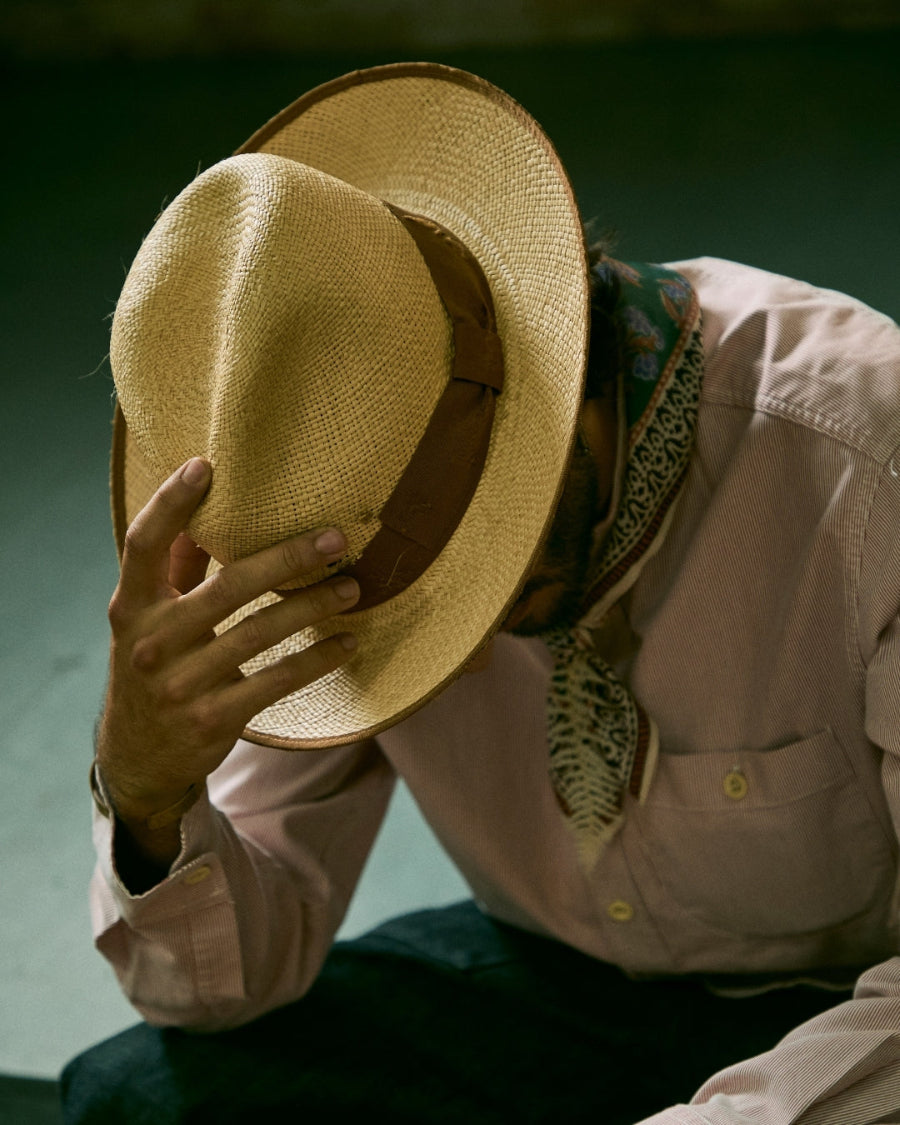
We use premium straw. It's the same material that defined refined straw hat making in Tuscany for centuries, and we use it for straightforward reasons: the fiber is thin enough to weave densely, strong enough to hold structure, and flexible enough to wear comfortably in heat.
It's not a heritage choice. It's a material choice: made because the material performs.
Raffia vs. Traditional Straw, What's Really Different
Not all straw hats are made from the same thing, and the difference matters more than most people realise.
Traditional wheat straw produces a thinner fiber than raffia, which allows for denser, more precise weaving. The result is a hat with clean lines, structural integrity, and a silhouette that holds across a full summer. Raffia, drawn from the Raphia palm, is thicker and more relaxed in character — well suited to casual, unstructured forms, but less appropriate for a hat designed to hold a specific shape.
And paper straw — which isn't straw at all, just twisted paper — doesn't belong in this conversation. No structural memory, no natural flexibility, and a lifespan measured in seasons rather than years.
How to tell if a straw hat is actually handmade
This is where it gets practical, because the market is full of hats that claim handmade and aren't.
Look at the weave. Machine weaves are perfect, every thread spaced identically, every section identical to the last. Human weaves are consistent but not perfect. On a genuinely handwoven hat, you'll notice a subtle rhythm to the variation: the spacing shifts slightly, in a pattern that reflects the movement of the weaver's hands. It's not a flaw. It's the signature.
Check the crown stitching. The inside crown of a handmade hat is stitched by hand. The stitches are neat, but you can see them: slightly spaced, slightly tactile. Run your finger along the inside. On a real piece you'll feel a faint texture. Factory stitching feels printed.
Feel the brim edge. A handmade brim is bound by hand, typically in natural linen or cotton. It's precise, but there's a warmth to it — a slight irregularity that tells you a person did this, not a heat press. Factory brims are usually sealed or bonded. They look cleaner. They feel like plastic.
Hold it and notice the weight. A handmade straw hat is slightly heavier at the crown and tapers toward the brim edge. That's not engineering — it's just how the material distributes when worked by hand. Factory hats feel uniform throughout. Uniform is the tell.
Durability and longevity: what to expect from a handmade straw hat
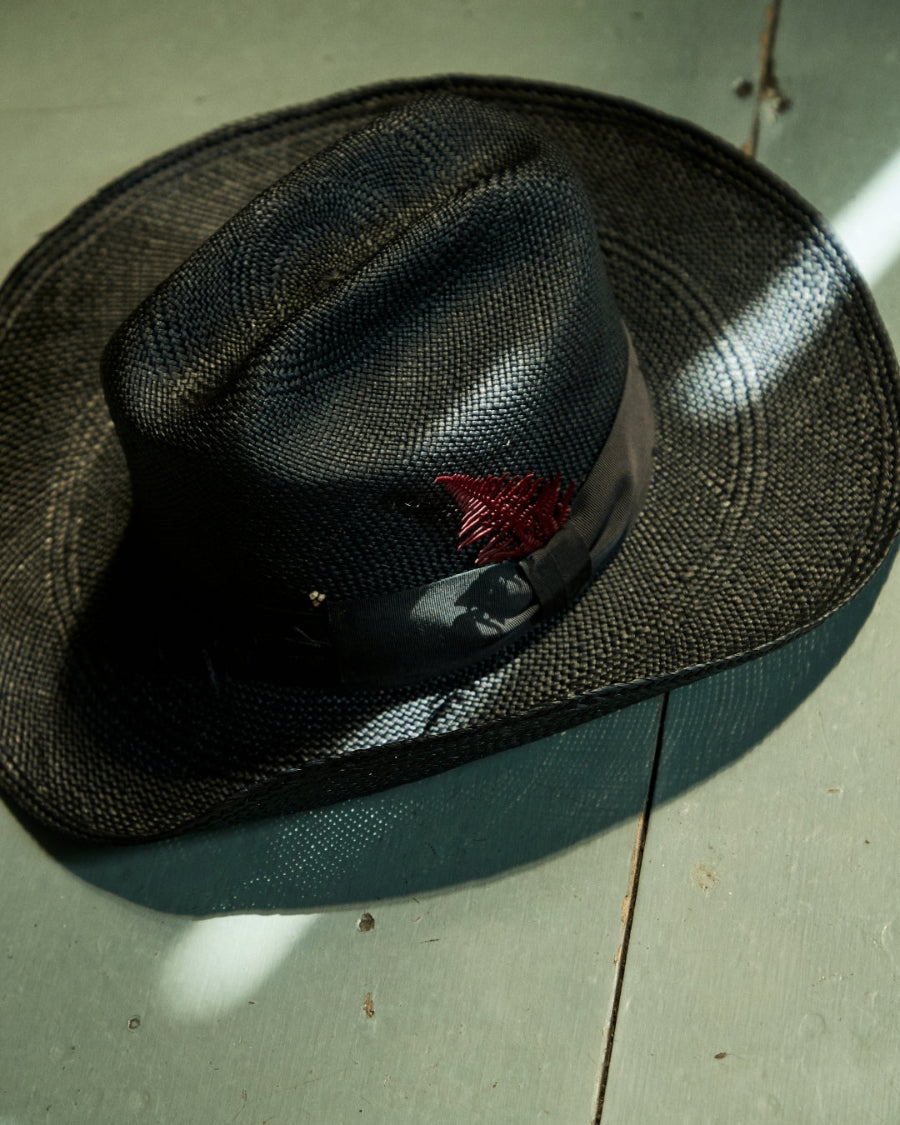
The durability of a handmade straw hat comes directly from its construction. Tighter weave means higher structural tension throughout — and that tension is what keeps a hat looking like a hat after years of use. A well-made handwoven straw hat, cared for properly, will last 15 years or more. That's not a marketing claim. It's a consequence of how the material behaves when it's worked correctly.
Longevity also depends on care, which is simpler than most people expect: light steam to restore shape if it gets squashed, storage away from extreme heat, occasional brushing to keep the weave clean. Neither straw nor raffia likes the washing machine.
The hats we make at SUPERDUPER are built with this kind of lifespan in mind, not as a promise, but as a natural result of the choices made at every stage of straw hat making.
The point
Quality, for us, isn't about scarcity or branding. It's about owning something that performs exactly as it should, for as long as it should, without asking anything complicated of you in return.
A handmade straw hat made with the right material, by someone who knows what they're doing, is one of those things. It becomes part of how you dress rather than something you're wearing. That's the distinction that matters, and it's the one we build toward with every hat that leaves our atelier.
Explore the SUPERDUPER handwoven straw collection. Each hat is made in our Florentine Atelier, with a virtual fitting available before you order.
'%3e%3cg id='Final-Copy-2_2_' transform='translate(1275.000000, 200.000000)'%3e%3cpath class='st0' d='M7.4,12.8h6.8l3.1-11.6H7.4C4.2,1.2,1.6,3.8,1.6,7S4.2,12.8,7.4,12.8z'/%3e%3c/g%3e%3c/g%3e%3c/g%3e%3c/g%3e%3cg id='final---dec.11-2020'%3e%3cg id='_x30_208-our-toggle' transform='translate(-1275.000000, -200.000000)'%3e%3cg id='Final-Copy-2' transform='translate(1275.000000, 200.000000)'%3e%3cpath class='st1' d='M22.6,0H7.4c-3.9,0-7,3.1-7,7s3.1,7,7,7h15.2c3.9,0,7-3.1,7-7S26.4,0,22.6,0z M1.6,7c0-3.2,2.6-5.8,5.8-5.8 h9.9l-3.1,11.6H7.4C4.2,12.8,1.6,10.2,1.6,7z'/%3e%3cpath id='x' class='st2' d='M24.6,4c0.2,0.2,0.2,0.6,0,0.8l0,0L22.5,7l2.2,2.2c0.2,0.2,0.2,0.6,0,0.8c-0.2,0.2-0.6,0.2-0.8,0 l0,0l-2.2-2.2L19.5,10c-0.2,0.2-0.6,0.2-0.8,0c-0.2-0.2-0.2-0.6,0-0.8l0,0L20.8,7l-2.2-2.2c-0.2-0.2-0.2-0.6,0-0.8 c0.2-0.2,0.6-0.2,0.8,0l0,0l2.2,2.2L23.8,4C24,3.8,24.4,3.8,24.6,4z'/%3e%3cpath id='y' class='st3' d='M12.7,4.1c0.2,0.2,0.3,0.6,0.1,0.8l0,0L8.6,9.8C8.5,9.9,8.4,10,8.3,10c-0.2,0.1-0.5,0.1-0.7-0.1l0,0 L5.4,7.7c-0.2-0.2-0.2-0.6,0-0.8c0.2-0.2,0.6-0.2,0.8,0l0,0L8,8.6l3.8-4.5C12,3.9,12.4,3.9,12.7,4.1z'/%3e%3c/g%3e%3c/g%3e%3c/g%3e%3c/svg%3e) Your Privacy Choices
Your Privacy Choices