

Unlock 10% off on your first order and gain access to exclusive, limited-edition projects.
How to Care for a Handmade Hat: The Complete Care Guide

A handmade hat is made to be worn. Not preserved behind glass. Not rotated monthly and padded with tissue. Worn. But wearing something daily means actually caring for it. At SUPERDUPER we make handmade hats in our Florentine Atelier, and every hat that leaves our workshop comes with a care sheet written by the hands that shaped it. This guide expands on that. It’s what our artisans do with their own hats, tested through real wear.
Daily Care Essentials
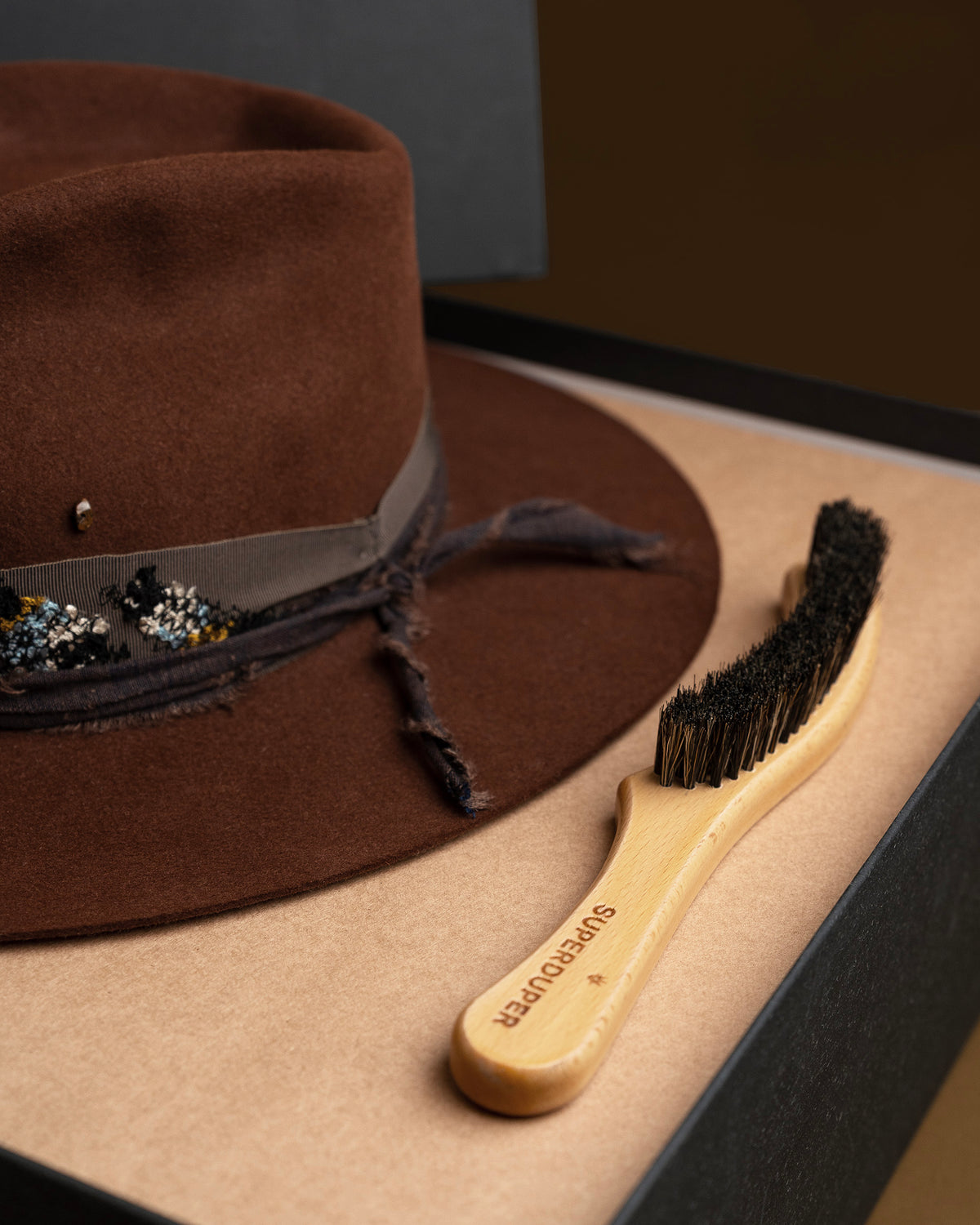
A handmade hat doesn’t need constant fussing. It needs consistency. Every time you take it off, set it crown-down on a clean, flat surface or hang it on a wooden peg. Never on a wire hanger; wire creates permanent creases in the crown. If your hat has accumulated dust or lint during the day, use a soft-bristled brush (a clean shoe brush works) and brush gently in the direction of the nap. For felt, this keeps the surface smooth. For straw, this keeps the weave clean and prevents debris from settling into the fibers. That’s it. Daily care is 20 seconds.
If your hat gets caught in light rain, don’t panic. Let it air-dry naturally on a flat surface, away from direct heat or sunlight. A hair dryer will warp it. A radiator will shrink it. Just air, time, and patience.
Cleaning Your Felt Hat
Felt is durable but not indestructible. Dust, salt, and body oils accumulate over months of regular wear. When you notice the nap looks dull or the crown feels slightly stiff, it’s time to clean.
For light surface cleaning, a stiff brush works. The kind designed for hats or a clean suede brush. Brush in the direction of the nap with medium pressure. You’ll see dust come off. Do this over a sink or trash so you’re not spreading it around your room.
For deeper cleaning, steam is your tool. Hold the hat crown-side up over a pot of just-boiled water (or use steam from a kettle or shower) at a distance where you can hold your hand there comfortably. Move the hat slowly through the steam, rotating it so the entire crown and brim get exposure. This does two things: the steam relaxes the felt fibers and helps them shed trapped oils and dust. You’ll see moisture release. Once the hat has been steamed, use a soft brush again to finish the cleaning. The felt will feel refreshed.
For stains (sweat marks, dirt on the band), target the area with a damp cloth and a tiny amount of mild soap. Wool felt can handle this. Use barely-damp (not wet) cloth, work gently, and rinse with another barely-damp cloth. Air-dry completely before wearing again.
Cleaning Your Straw Hat
Straw is more delicate than felt in one specific way: it can crack if it dries too quickly or gets too much direct heat. Otherwise, it’s remarkably durable.
For daily dust, a soft brush is enough. The weave naturally sheds surface debris.
For deeper cleaning, water is actually your friend with straw. Use a soft brush with cool water (not hot) and apply gently to any visible soiling. The water won’t damage the straw. Raffia is more forgiving here than traditional straw; you can be slightly more aggressive. Let it air-dry in shade, never in direct sun or heat.
If sweat has stained the band or inner crown, a barely-damp cloth with a drop of mild soap works. Work it gently into the material, rinse with a clean damp cloth, and air-dry thoroughly. Straw takes longer to dry than felt, so plan accordingly.
Never submerge a straw hat, and never machine-wash it. The agitation will crack the weave and the drying will cause shrinkage you can’t reverse.
Steaming and Reshaping
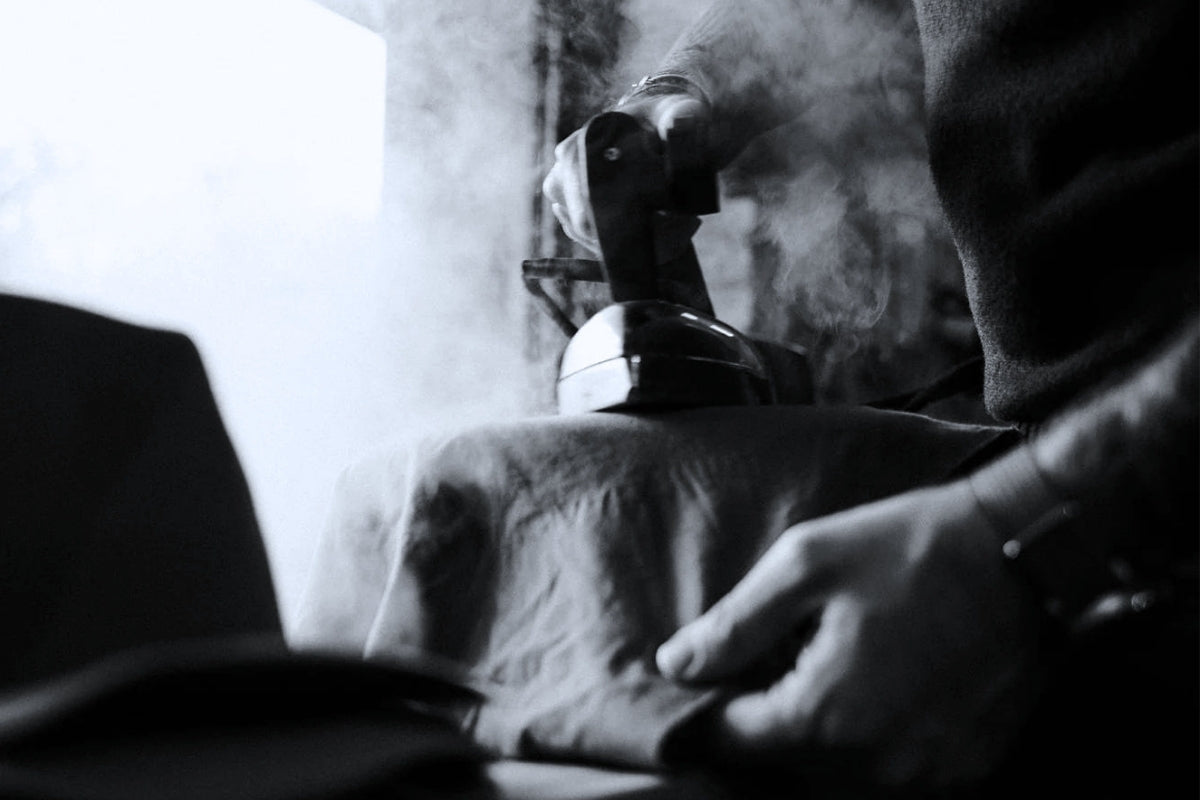
This is where handmade hats earn their keep. Steam relaxes the fibers, which means you can reshape. It’s the tool that lets you recover from being crushed in a bag, creased by accident, or reshaped by weather.
You need a source of steam: a kettle, a pot of boiling water, a shower with a hot-steam cycle, or a garment steamer. You need 3-5 minutes per session. Here’s how:
-
Hold the hat crown-up at a comfortable distance from the steam source (far enough that your hand doesn’t get scalded). Rotate slowly through the steam, making sure the entire crown and brim get exposure. Watch the material begin to visibly relax. The felt or straw will darken slightly from moisture, and you’ll feel the structure soften.
-
Once fully steamed (3-5 minutes for a full reset), remove the hat from the steam and immediately reshape it with your hands. Crown flattened? Press it back up gently with your palm. Brim creased? Run your thumbs along the underside to restore the curve. Work quickly while the material is still warm and pliable. You have about 30-60 seconds before it sets.
-
Set it crown-down on a flat surface to cool and dry completely. This locks in the new shape. Don’t wear it again until it’s fully dry (30 minutes to an hour depending on humidity).
For minor reshaping (a small crease, a pinched crown), a handheld steamer or even a kettle works fine. For a complete reset or a hat that’s been heavily crushed, a shower with a steam cycle or a garment steamer gives you more consistent heat.
Storage: Short-Term
If you’re rotating hats or storing one for a few weeks, keep it simple. Set it crown-down on a shelf in a closet, or hang it on a wooden peg in a cool, dry place. Not touching anything else, not in a tight space.
Don’t use tissue paper, plastic bags, or hat boxes for short-term storage. Tissue traps moisture. Plastic creates humidity. Boxes, if they’re tight-fitting, can deform the crown over time. Air circulation is better.
If you live somewhere very humid and notice your felt getting soft or your straw getting limp, a dry closet (even a cedar closet) is better than ambient humidity. But for most people, just setting it on a shelf is fine.
Storage: Long-Term
If you’re putting a hat away for a season (or longer), give it a bit more attention.
Clean it first, using the methods above for your material. A clean hat stores better than a dirty one. Once it’s clean and completely dry, place it crown-down on a shelf or in a box (with the lid off for ventilation) in a cool, dry place. Temperature consistency matters more than temperature itself. A cool closet or spare shelf is better than an attic that heats up in summer or a basement that floods in spring.
If you’re using a box, line the bottom with acid-free tissue or unbleached cotton cloth (not plastic). Leave the lid off or propped open for air circulation. The goal is protection from dust and insects, not airtight storage.
Store the hat away from direct sunlight (it can fade), away from heating vents, and away from anywhere damp. A hat stored in good conditions can sit for years and come out looking exactly as it did when you put it away.
When to Take It to a Professional
You can do a lot at home. You can’t do everything.
If the sweatband is damaged or the inner lining has torn, take it to us. These are structural repairs that require stitching by someone who understands hat construction.
If the brim edge binding is coming loose, our artisans can resew it. If the crown has a visible crease that multiple steaming sessions won’t fix, or if the felt has matted down in a way that brushing and steaming don’t restore, a professional reshaping under a wooden block might be necessary.
If you suspect the hat has shrunk (it suddenly feels too tight, or the proportions look off), an artisan can assess whether it’s worth stretching or if the felt has genuinely changed. Not all damage can be undone.
At SUPERDUPER, every hat is crafted to be worn for years, and passed down for generations. That’s why we offer a complimentary lifetime restoration service, carried out by our artisans whenever your hat needs care. For any questions, feel free to contact us.
What NOT to Do
This is the part where we’re direct: there are ways to ruin a hat quickly.
Do not machine-wash. Ever. The agitation, the heat, the spinning: it will felt (or re-felt) the material, shrink it, and make it unwearable.
Do not put it in a dryer. Heat will cause permanent shrinkage and may melt components of the band or trim.
Do not apply direct heat from a hair dryer, radiator, or oven to dry it fast. You’re making creases, shrinking fibers, and potentially damaging the material.
Do not use wire hangers. They create creases in the crown that steam won’t always fix. Wooden pegs or flat surfaces only.
Do not store it in direct sunlight for extended periods. Felt and straw both fade. A bright window is not storage.
Do not try to bleach or dye a hat yourself. You’ll likely ruin the material and possibly the interior fittings.
Do not fold it in half. Flatten it gently if you must pack it, but don’t create a crease that runs the length of the crown.
Why This Matters
A handmade hat made in Florence is built to last. The materials are good, the construction is sound, and the attention to detail means it’ll hold its shape through real wear. But that longevity depends on you. A hat that gets brushed, stored well, steamed occasionally, and taken seriously will look better, feel better, and last longer than the same hat neglected.
Every hat that leaves our workshop comes with a care sheet written by the artisans who shaped it. This guide is an expansion of that knowledge. Wear your hat. Care for it. It’s the only way to understand why a handmade hat is worth the investment.
Ready to start? Explore our full Felt collection or the handwoven Straw collection for summer, and begin with confidence knowing you understand how to keep either looking like new.
'%3e%3cg id='Final-Copy-2_2_' transform='translate(1275.000000, 200.000000)'%3e%3cpath class='st0' d='M7.4,12.8h6.8l3.1-11.6H7.4C4.2,1.2,1.6,3.8,1.6,7S4.2,12.8,7.4,12.8z'/%3e%3c/g%3e%3c/g%3e%3c/g%3e%3c/g%3e%3cg id='final---dec.11-2020'%3e%3cg id='_x30_208-our-toggle' transform='translate(-1275.000000, -200.000000)'%3e%3cg id='Final-Copy-2' transform='translate(1275.000000, 200.000000)'%3e%3cpath class='st1' d='M22.6,0H7.4c-3.9,0-7,3.1-7,7s3.1,7,7,7h15.2c3.9,0,7-3.1,7-7S26.4,0,22.6,0z M1.6,7c0-3.2,2.6-5.8,5.8-5.8 h9.9l-3.1,11.6H7.4C4.2,12.8,1.6,10.2,1.6,7z'/%3e%3cpath id='x' class='st2' d='M24.6,4c0.2,0.2,0.2,0.6,0,0.8l0,0L22.5,7l2.2,2.2c0.2,0.2,0.2,0.6,0,0.8c-0.2,0.2-0.6,0.2-0.8,0 l0,0l-2.2-2.2L19.5,10c-0.2,0.2-0.6,0.2-0.8,0c-0.2-0.2-0.2-0.6,0-0.8l0,0L20.8,7l-2.2-2.2c-0.2-0.2-0.2-0.6,0-0.8 c0.2-0.2,0.6-0.2,0.8,0l0,0l2.2,2.2L23.8,4C24,3.8,24.4,3.8,24.6,4z'/%3e%3cpath id='y' class='st3' d='M12.7,4.1c0.2,0.2,0.3,0.6,0.1,0.8l0,0L8.6,9.8C8.5,9.9,8.4,10,8.3,10c-0.2,0.1-0.5,0.1-0.7-0.1l0,0 L5.4,7.7c-0.2-0.2-0.2-0.6,0-0.8c0.2-0.2,0.6-0.2,0.8,0l0,0L8,8.6l3.8-4.5C12,3.9,12.4,3.9,12.7,4.1z'/%3e%3c/g%3e%3c/g%3e%3c/g%3e%3c/svg%3e) Your Privacy Choices
Your Privacy Choices